
Definition
A deduplication Feature allows to check for duplicates before creating a new object.
Usage
|
Steps |
Preview |
|
|---|---|---|
|
1 |
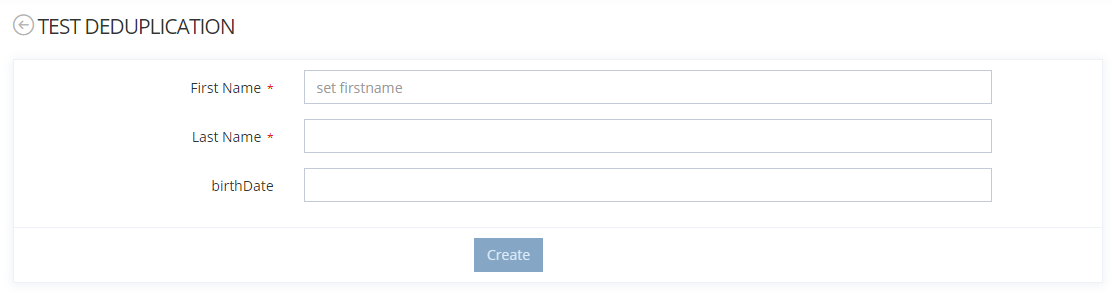
Fill in values for at least mandatory Attributes. |
|
|
2 |
Click on the "Create" button.
|
|
|
3 |
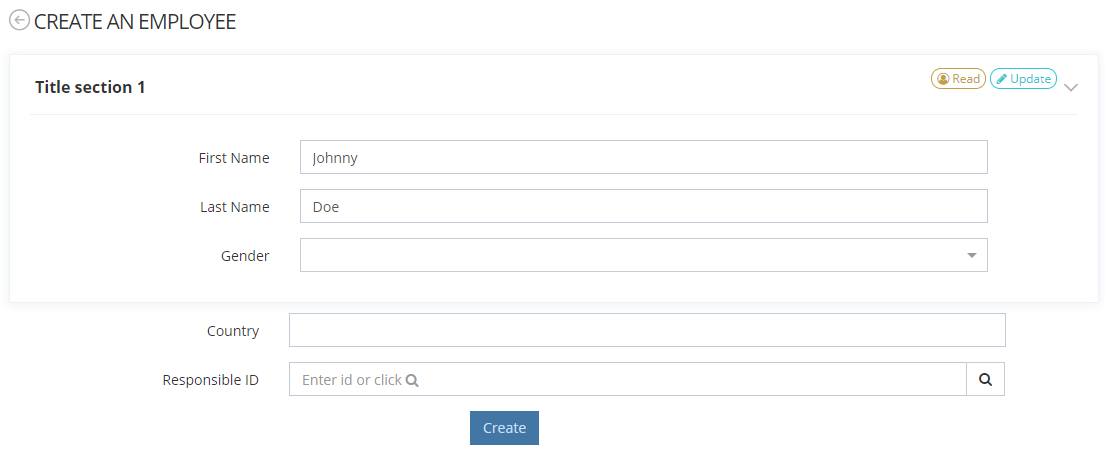
2 cases are possible:
|
|
|
4 |
|
|
|
5 |
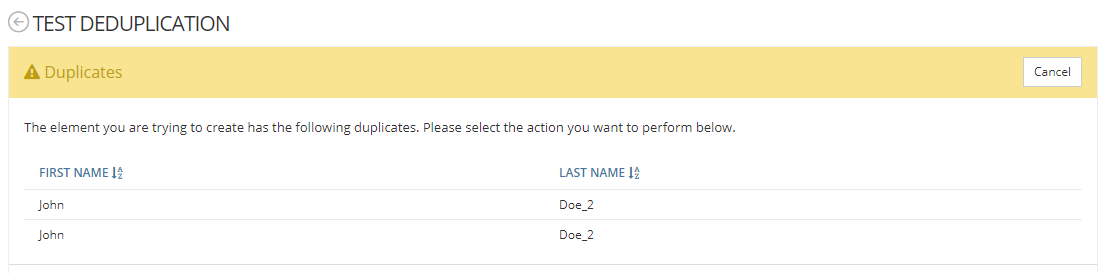
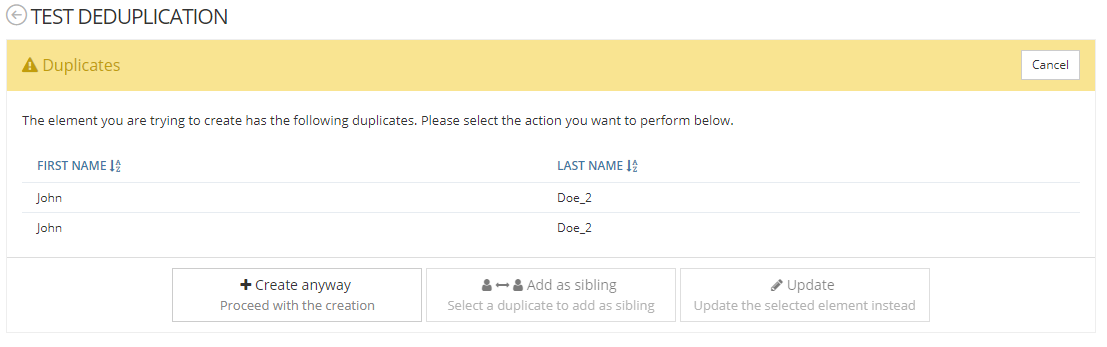
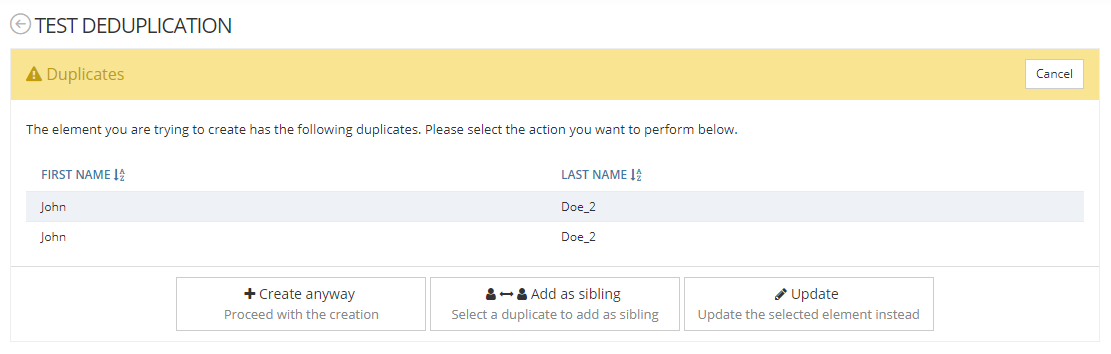
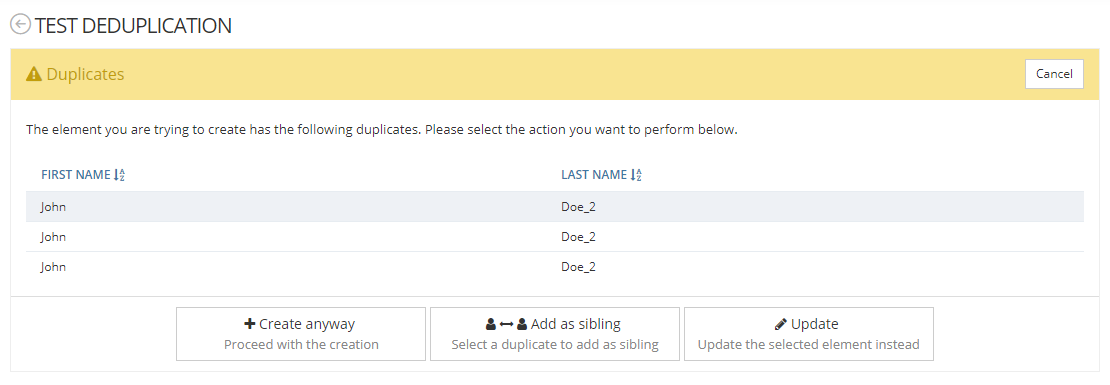
A duplicate is found. 3 cases are possible:
The user is reintegrated in a classic create feature process. |
|
|
6 |
|
|
|
7 |
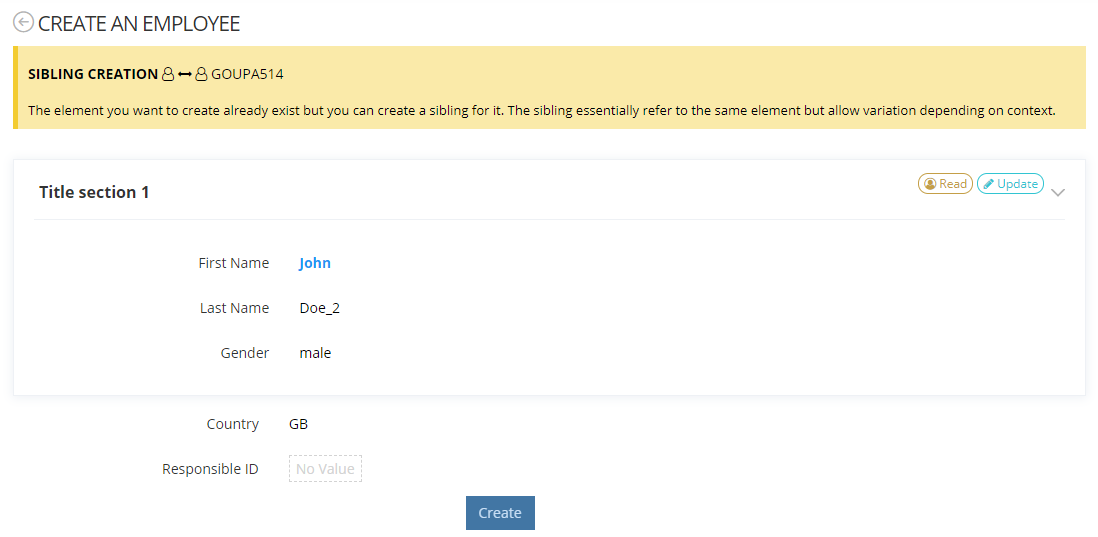
The user is redirected to the Feature that is configured in the <createFeature> tag. A banner (not configurable) reminds that the user is creating a sibling.
|
|
|
8 |
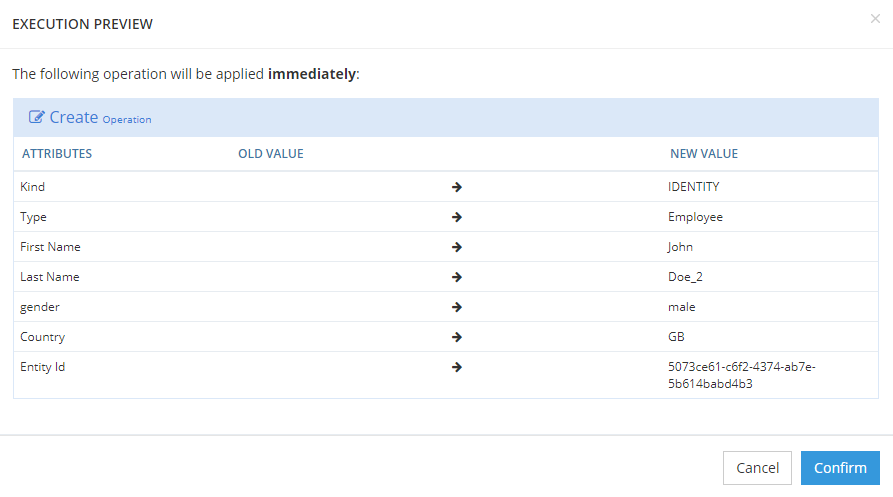
The execution preview is displayed (according to the submit configuration).
|
|
|
9 |
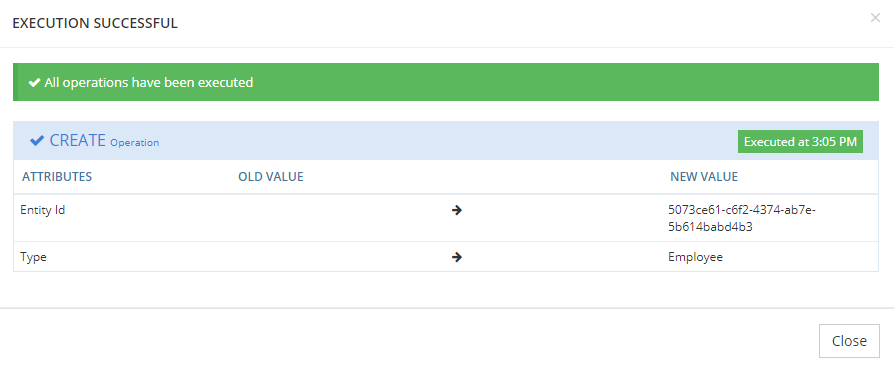
The execution is displayed (according to the submit configuration).
|
|
|
10 |
The user is reintegrated in a classic update feature process. |
|
Configuration
Prerequisite
The following prerequisites are mandatory before configuring a deduplication Feature:
-
Have configured an object type (Identity, Organization, Resource, Role or Role Publication).
-
All attributes definition listed in the deduplication Feature must be created and linked to the object type.
-
Have configured a deduplication policy.
-
Have created a object in order to check it.
Properties
Mandatory configuration elements
Global configuration elements are detailed on the Feature page.
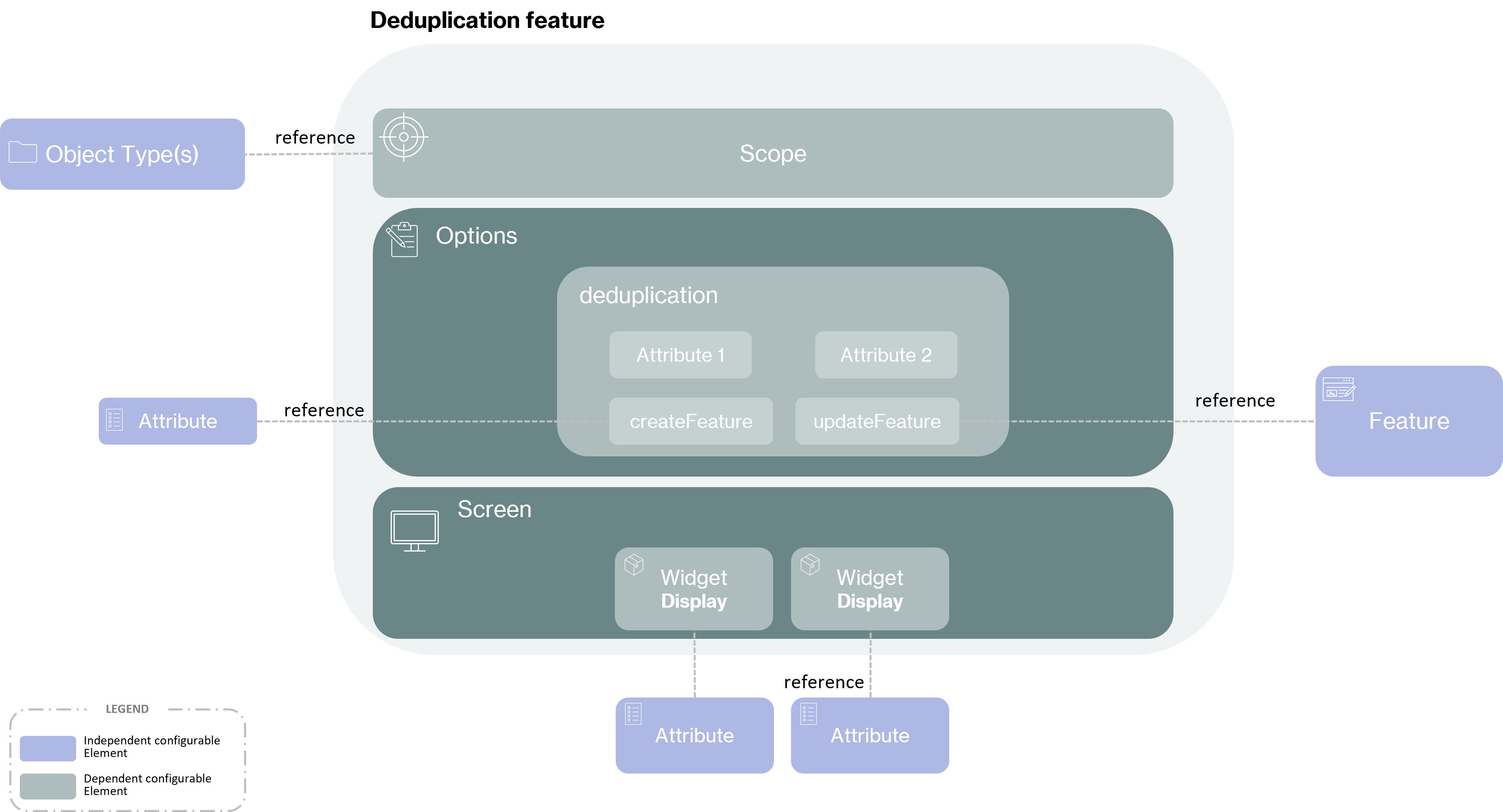
Configuring the Deduplication option is also mandatory in a Deduplication Feature, if not, the Feature will not be usable.
Deduplication option
|
Property name |
Type |
Mandatory |
Description |
Values (default value in bold) |
|---|---|---|---|---|
|
forceCreation |
|
YES |
Used to indicate if the user can create the Object even if a duplicate was found. In this case, a "Create anyway" button is displayed. Note that this will just result in allowing the user to navigate to a CREATE Feature and ask the deduplication process to be ignored. By default the deduplication will be ignored but one can forbid it on the OPERATION configuration of type CREATE by specifying a "bypassDeduplication" flag to false in its requestOptions. |
true, false |
|
allowSiblingCreation |
|
YES |
Used to indicate if the user can create a sibling if a duplicate was found.
|
true, false |
|
columns |
- |
YES |
Used to display the configured Attributes when a duplicate is found. If you do not configure a column, the default value is created. You must add <dataKey> and <type> values in order to specify which Attribute(s) will be displayed. |
- |
|
updateFeature |
|
YES |
Used to indicate the id of the update Feature to redirect the user if the chosen option is “Update”. |
- |
|
createFeature |
|
YES |
Used to indicate the id of the create Feature to redirect the user if the chosen option is “Add as sibling” or “Create anyway”. |
- |
Recommended configuration elements
The following requirements are recommended to build the XML configuration:
-
Options:
-
Views: define a unified set of elements placed in tab.
-
Sections: define related elements inside a View.
-
Columns: define Columns to display duplicates.
-
Frame: define a frame around the Screen or Section.
-
Authentication: define the authentication level to access Features.
-
OperationOnSelf: non-functional on a deduplication Feature
-
HomeTile: use to access a Feature from the home page.
If attributes are configured as mandatory in the Object Type, they must be configured in the Feature.
Example
Read Next
-
Deduplication -
Create A Feature of type Create is used to create objects by listing attributes.
-
Hub A hub Feature is used to list several Features on tabs on the same screen.
-
Read A Feature of type Read is used to read the content of created objects by listing attributes.
-
Search A Search feature is used to allow search for objects and displays the results in a table.
-
Update An Update feature is used to allow modifications on objects by listing attributes.
-
Bulk A Feature of type bulk allows to apply several operations on these objects at the same time.
-
Raw Update A Raw Update feature is used to perform modifications on all attributes on objects (built-in and related to object).
-
UI -
UI for Object A Ui for Object (UI_FOR_OBJECT in XML) is used to configure a dedicated element on an object, like a Role Assignment Widget or a Role Dashboard Widget.
-
Application Portal An application portal feature allows users to have a quick and simple access to all his applications.